"I Thought I Was Just Failing at Midlife... Until I Learned What No One Told Me About Perimenopause"

I'd wake up at 2 a.m., heart racing, drenched in sweat, staring at the ceiling doing math on how many hours were left before my alarm. The next day I'd drag myself through work like my brain was full of cotton -- forgetting words in meetings, rereading the same email three times before it made sense.
At home, the smallest things set me off.
My kids would argue, my partner would ask an innocent question, and I'd snap like a bomb went off. Five minutes later I'd be in the bathroom, crying quietly, wondering, "Who is this person?"
The mirror didn't help.
There was this new ring of weight around my middle that clung no matter how "good" I was. I cut carbs. I cut wine. I worked out more. I did everything you're supposed to do when you gain weight.
The scale didn't care.
And then there was the part I really didn't talk about: sex hurt. I felt dry, fragile, like my body was rejecting intimacy. It was easier to say "I'm just tired" than admit how broken I felt.
If you'd asked me then, I would've told you I was just stressed, getting older, maybe not trying hard enough.
That's what my doctors told me too.
I listed everything: the night sweats, the anxiety that came out of nowhere, the brain fog, the weight gain, the zero sex drive, the feeling like I might explode over nothing.
.avif)
She glanced at my labs and said, "Everything looks normal. You're probably under a lot of stress. It's very common at your age."
She offered me an antidepressant.
The second doctor told me I was "too young for menopause" and suggested I "try yoga" and "give it time."
The third said, "Once you've gone a full year without a period, then we can talk about menopause. Until then, it's just fluctuations."
Each visit, I walked out with the same message:
Nothing's wrong. You're fine. Tough it out.
But I wasn't fine.
I was watching my life shrink around me -- my patience, my joy, my confidence at work -- and being told it was just "normal."
So I did what a lot of women do when the system shrugs.
I turned to Google at 3 a.m.
I cut gluten. Then dairy. Then sugar.
I bought the magnesium drink, the adaptogens, the fancy tracker.
The Night I Finally Saw My Story in Someone Else's Post
One night, scrolling through a forum, I saw a woman describe her life:
Rage over nothing
Crushing anxiety
Brain fog at work
Zero libido and painful sex
Random weight gain around the middle
Not "I'm a failure."
Not "I'm lazy."
Not "I'm crazy."
I felt two things at once:
Relief -- because suddenly everything made sense.
Anger -- because I had been suffering for years without anyone connecting the dots.
If this sounds familiar, keep reading.
Because what I discovered next is the thing I wish someone had sat me down and told me at 40.
The Part Nobody Bothered to Tell Us
Here's what I eventually learned from digging, asking questions, and finally talking to someone who specializes in this:
Your estrogen and progesterone don't politely decline -- they swing.
Those swings impact your brain, sleep, mood, weight, and sex life -- not just hot flashes.
"Normal" lab ranges do not automatically mean your life feels normal. Symptoms matter too.
In other words:
No, you're not weak.
No, you're not imagining it.
And no, you don't have to white-knuckle this.
But there's a reason your regular doctors keep saying "you're fine."
Most of them weren't trained to see this as a distinct phase that needs its own approach. They're doing their best with the tools they have. Those tools just weren't built for midlife women like us.
That realization is what led me to someone who lives and breathes this work every day.
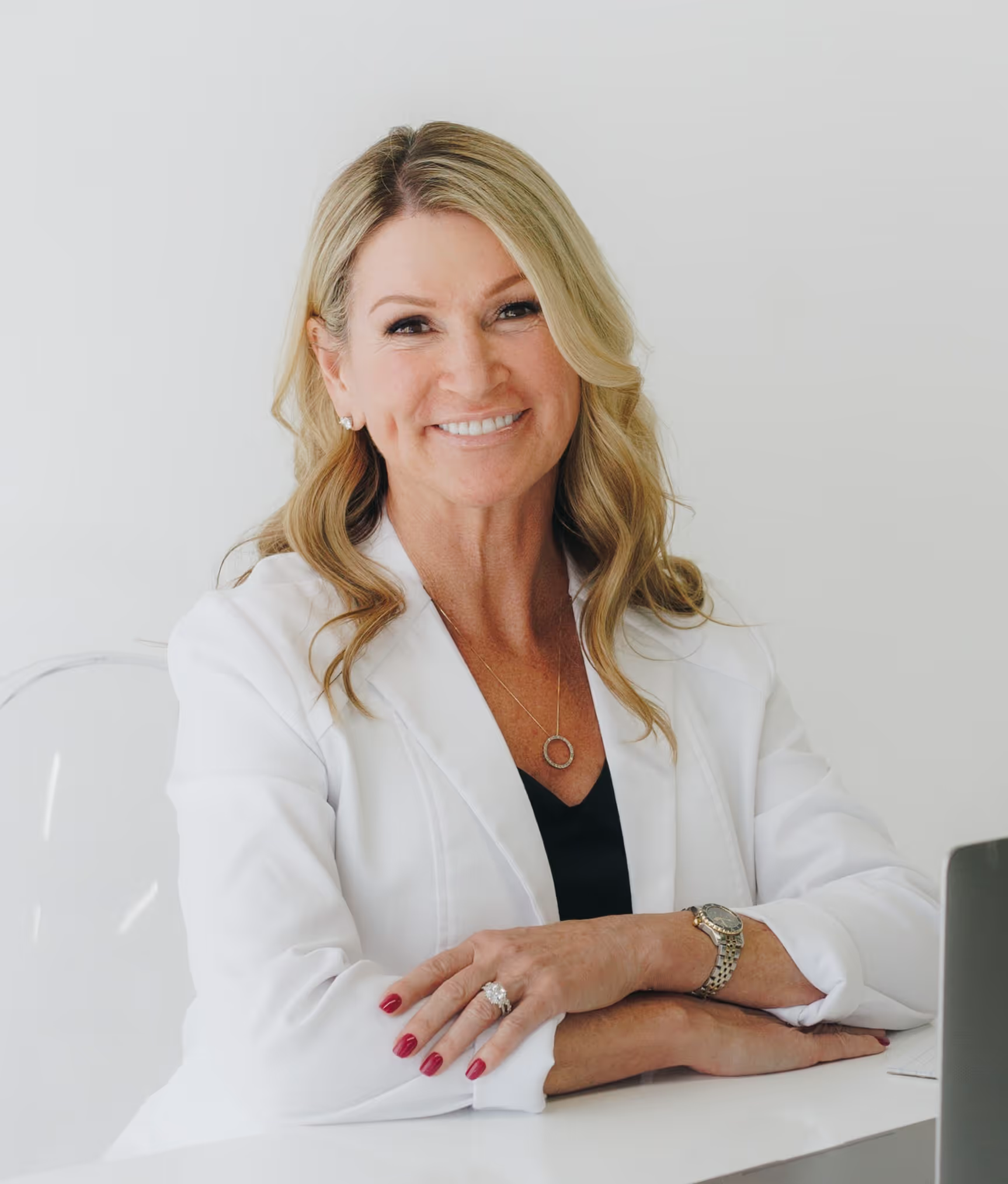
Her name is Dr. Dana Culp.
It was this:She admitted that she went through the same maze many of us are in right now.She saw provider after provider, got brushed off, got catch-all solutions that didn't fit, and felt that same mix of fear, shame, and anger.
She didn't just read about midlife in a textbook. She lived it.
.avif)
That's why she founded Thrive Midlife Medicine -- an online clinic that focuses only on perimenopause and menopause care for women in California and Nevada.
No prenatal or fertility care.
No taking half a day off work to sit in a waiting room.
Just one thing: helping women in midlife stop feeling like strangers in their own bodies.
Here's what makes what she does different from what most of us have experienced:
She stays current on the new research about hormone therapy, brain health, bone protection, and non-hormonal options.
She designed her practice around the exact gap that failed her -- and us.
Doctor of Nursing Practice, Samuel Merritt University
Board-Certified, American Association of Nurse Practitioners
First hand understanding of perimenopause & menopause
25+ years of clinical experience
Telehealth -- California & Nevada
Covered by many major insurance plans
If you're like me, the moment someone mentions hormone therapy, your brain pulls up scary headlines.
Breast cancer. Heart attacks. Stroke.
For years, I wrote off hormone therapy without even realizing that the most alarming news was based on old data and misinterpretations.
The FDA has requested the removal of "black box" warnings on these drugs, which caused women to under-utilize hormone therapy.
You deserve to have individualized care based on your health history, risk factors, and goals.
That conversation is what Dana has with her patients every day.
What It Actually Looks Like to Work With a Menopause-Only Specialist
Thrive Midlife Medicine isn't a random "online clinic."
It's telehealth designed for women in exactly our shoes.
Your whole story matters: symptoms, history, labs, cycle changes, mental health, relationships.
The goal is not just "stop hot flashes." It's sleep, mood, sex, energy, weight, and long-term health.
-- Kristie R.
-- Jane
-- Marie
But it's targeted care for a stage of life that has been ignored and oversimplified for too long.
"I don't even know if this is perimenopause or something else."
"I've wasted money before. I'm scared to be disappointed again."
.avif)
A free 15-minute consult.
There's no catch. This isn't a bait-and-switch.
It's a short, structured conversation where you can:
Get an expert's perspective on whether your symptoms sound like perimenopause or something else.
Find out if Dana Culp and Thrive Midlife Medicine are a good fit for you.
For me, just having someone say, "What you're experiencing is real, and here's why" dropped my anxiety in half.
"Is This Really Worth Doing Right Now?"
Only you can answer that.
But here's what I wish someone had asked me sooner:
How many more nights are you willing to lie awake, drenched in sweat, doing math on the clock?
How many more mornings can you show up to work wondering if people are starting to notice you're not as sharp?
How much longer do you want to walk on eggshells with the people you love because you don't trust your own reactions?
How many more months do you want to spend Googling in circles and trying random fixes in the dark?
Midlife is not a mistake in the design.
It's a transition.
But transitions require support when the rest of the world keeps saying "you're fine."
You don't have to have everything figured out to take 15 minutes and talk to someone who spends all day, every day, helping women exactly like you.
At the end of that conversation, you'll know more than you do right now.
Maybe you'll realize, "Yes, this is perimenopause, and there is a plan." Maybe you'll find out it's something else entirely -- and get guidance on where to go next.
Either way, you'll stop suffering in the dark.
You've carried everyone else through their seasons.